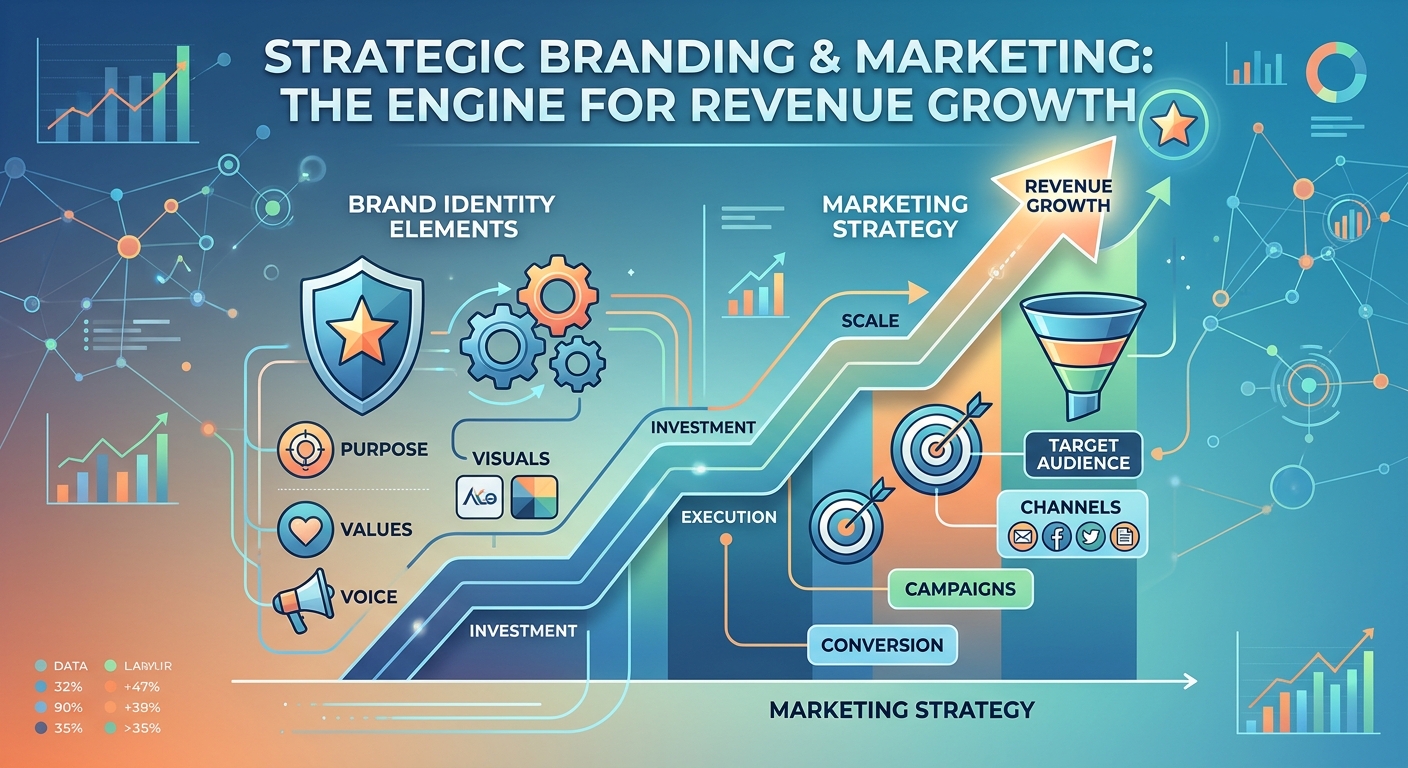
In today’s competitive business landscape, branding is much more than a logo, color palette, or catchy slogan. It is one of the most powerful assets a business can develop to influence customer perception, build trust, and increase revenue.
A strong brand creates an emotional connection with customers, communicates a company’s value, and gives people a compelling reason to choose one business over another. When branding is done strategically, it becomes a direct contributor to business growth and long-term profitability.
But how exactly does branding impact revenue? Let’s explore the connection and why investing in your brand can deliver measurable financial results.
Ready to Master Your Brand’s ROI?
Branding shouldn’t be a guessing game, and you don’t have to navigate the path to predictable growth alone. Whether you’re looking to redefine your position, command premium pricing, or optimize your marketing spend, our strategic team is here to help.
1. Branding Builds Trust and Customer Confidence
Trust is one of the most important factors influencing purchasing decisions. Customers are more likely to buy from businesses they recognize, understand, and believe in.
Consistent branding helps establish credibility by creating a professional and recognizable business identity. From your website and social media presence to your customer service and marketing materials, every interaction contributes to how customers perceive your company.
When customers trust your brand, they are more likely to:
- Choose your products or services over competitors.
- Feel confident making purchasing decisions.
- Recommend your business to others.
- Return for future purchases.
The revenue connection: Greater customer confidence reduces hesitation during the buying process, helping improve conversion rates and generate more sales.
2. Strong Branding Allows You to Charge Premium Prices
One of the biggest advantages of effective branding is the ability to differentiate your business beyond price.
When customers perceive a brand as valuable, reliable, and unique, they are often willing to pay more for its products or services.
Consider well-established brands such as Apple and Nike. Their branding goes beyond the products they sell. They communicate innovation, lifestyle, performance, and identity.
Customers aren’t simply purchasing a product; they’re purchasing the experience and meaning associated with the brand.
Businesses that establish a strong brand position can:
- Reduce dependence on price discounts.
- Increase perceived product value.
- Improve profit margins.
- Attract customers who prioritize quality over the lowest price.
The revenue connection: Strong brand positioning can support higher average selling prices and healthier profit margins.
3. Brand Recognition Drives More Sales
Think about the last time you purchased a product. Did you choose a brand you already knew, or did you take a chance on an unfamiliar alternative?
Brand recognition plays a significant role in consumer behavior. Familiar brands are often easier to remember and more likely to make it onto a customer’s shortlist when they are ready to purchase.
Consistent branding across multiple channels helps businesses remain visible and memorable.
Important brand-building channels include:
- Website and search engine presence.
- Social media platforms.
- Email marketing campaigns.
- Digital and traditional advertising.
- Packaging and customer communications.
- Industry events and networking.
The more consistently customers encounter your brand, the greater the opportunity to build familiarity and recognition.
The revenue connection: Increased brand awareness can expand your potential customer base, generate more qualified leads, and create additional sales opportunities.
4. Branding Creates Customer Loyalty and Repeat Revenue
Acquiring new customers is important, but retaining existing customers is equally valuable.
A strong brand gives customers reasons to continue choosing your business even when competitors offer similar products or services.
Brand loyalty often develops when customers consistently experience:
- Reliable product or service quality.
- Positive customer experiences.
- Clear and authentic communication.
- Shared values and beliefs.
- A sense of connection with the company.
When customers develop an emotional connection with a brand, their relationship can extend beyond individual transactions.
They become repeat buyers, advocates, and sometimes your most effective source of referrals.
The revenue connection: Customer loyalty supports recurring revenue, increases customer lifetime value (CLV), and can reduce the cost of continually acquiring new customers.
5. Branding Differentiates Your Business From Competitors
In crowded markets, businesses often compete for the same customers with similar products, services, and pricing.
Without a clear brand identity, customers may struggle to understand why they should choose your company.
Effective branding answers three essential questions:
- Who are you as a business?
- What makes your products or services different?
- Why should customers choose you?
Your brand positioning should communicate your unique value proposition in a way that resonates with your target audience.
For example, a company might differentiate itself through exceptional customer service, specialized expertise, sustainability, innovation, convenience, or premium quality.
When customers clearly understand what makes your business different, price becomes less likely to be the only deciding factor.
The revenue connection: Strong differentiation helps attract your ideal customers, improve conversion opportunities, and protect your business from competing solely on price.
6. Consistent Branding Improves Marketing Effectiveness
Marketing campaigns are more effective when they communicate a consistent brand message.
Imagine seeing one message on social media, a completely different tone on a company’s website, and an inconsistent visual identity in its advertisements. This disconnect can create confusion and weaken customer confidence.
Consistent branding creates a unified experience across every customer touchpoint.
It also makes marketing efforts more recognizable, helping businesses build familiarity over time rather than starting from scratch with every campaign.
A cohesive brand strategy should include:
- A clearly defined brand voice and personality.
- Consistent visual identity.
- Messaging that reflects your business values.
- A recognizable value proposition.
- Consistent customer experiences across platforms.
The revenue connection: Consistency strengthens marketing recognition, reinforces customer trust, and helps businesses get more value from their marketing investments.
7. Branding Increases Long-Term Business Value
Branding is not simply a short-term marketing tactic. It is a long-term business investment.
A recognizable and trusted brand can become a valuable intangible asset that strengthens a company’s competitive position.
Over time, strong branding can contribute to:
- Greater customer retention.
- Stronger market positioning.
- Increased referral business.
- More predictable demand.
- Greater opportunities for expansion.
- Improved business resilience.
A business with a well-established brand may also find it easier to introduce new products, enter new markets, and build strategic partnerships because customers already understand and recognize its identity.
The revenue connection: A strong brand creates opportunities for sustainable growth, helping businesses generate revenue beyond individual marketing campaigns or transactions.
How to Measure the Financial Impact of Branding
Although branding includes creative and emotional elements, its business impact can be evaluated through measurable performance indicators.
Here are some important metrics to monitor:
| Branding metric | What it measures | Revenue impact |
|---|---|---|
| Brand awareness | How familiar customers are with your brand | Potential customer growth |
| Conversion rate | Percentage of prospects who become customers | More sales |
| Customer lifetime value | Revenue generated per customer over time | Higher long-term revenue |
| Customer retention rate | Percentage of customers who continue buying | Recurring revenue |
| Average order value | Average amount spent per transaction | Increased sales value |
| Referral rate | Customers acquired through recommendations | Lower acquisition costs |
| Gross profit margin | Revenue remaining after cost of goods sold | Profitability |
Tracking these metrics allows businesses to evaluate whether their branding strategy is contributing to stronger commercial performance.
One important consideration: branding does not generate revenue in isolation. Its impact works alongside product quality, pricing, sales execution, customer service, and overall business strategy.
Practical Ways to Strengthen Your Brand and Increase Revenue
If you want your branding efforts to contribute more directly to business growth, start with these actionable steps:
1. Define your brand positioning.
Understand your target audience, identify your competitive advantages, and clearly communicate what makes your business valuable.
2. Create a consistent brand identity.
Develop recognizable visual elements, messaging, and communication guidelines that remain consistent across every platform.
3. Understand your customers.
Research customer needs, purchasing behaviors, expectations, and challenges. Use these insights to create messaging that connects with the right audience.
4. Deliver on your brand promise.
Your customer experience must match what your marketing communicates. Trust grows when businesses consistently meet or exceed expectations.
5. Invest in brand visibility.
Use content marketing, social media, search engine optimization, public relations, and strategic advertising to increase brand awareness.
6. Measure performance and improve.
Monitor customer acquisition, retention, conversion rates, brand awareness, and revenue trends to understand which strategies are delivering results.
Conclusion: Branding Is an Investment in Revenue Growth
The connection between branding and revenue is undeniable. A strong brand builds trust, increases recognition, supports premium pricing, encourages customer loyalty, and differentiates your business in competitive markets.
While branding may not produce immediate sales in every instance, its long-term influence can significantly strengthen a company’s ability to attract customers, retain them, and generate sustainable revenue.
The most successful businesses understand that branding is not just about looking good. It is about creating a meaningful identity, communicating value, and delivering an experience that customers want to return to.
Ultimately, your brand is more than what people see. It is what people believe about your business—and that belief can have a powerful impact on your bottom line.