For decades, digital marketing has been a discipline of judgment. Marketers have relied on intuition, experience, and manual analysis to decide which messages reach which audiences, and when. Today, that fundamental dynamic is shifting.
Artificial Intelligence (AI) has moved beyond the “hype” phase to become the central nervous system of modern marketing. It isn’t just a new tool; it is a fundamental shift in how we handle the complexity of the digital landscape. As the volume of data generated by consumer interactions grows exponentially, AI acts as the “telescope” that allows marketers to see patterns that were once invisible.
From Manual Control to Amplified Judgment
The most common misconception about AI is that it is here to replace the marketer. In reality, AI handles the complexity, while humans define the intent.
In the past, a campaign manager might have optimized a few dozen ad sets. Today, AI-driven platforms can process over 20 million signals every second evaluating context, inventory, and user propensity in real-time. By automating the “grunt work” of data analysis and repetitive task execution, AI allows human marketers to pivot from manual operation to high-level strategy and creative oversight.
Key Pillars of AI in Marketing
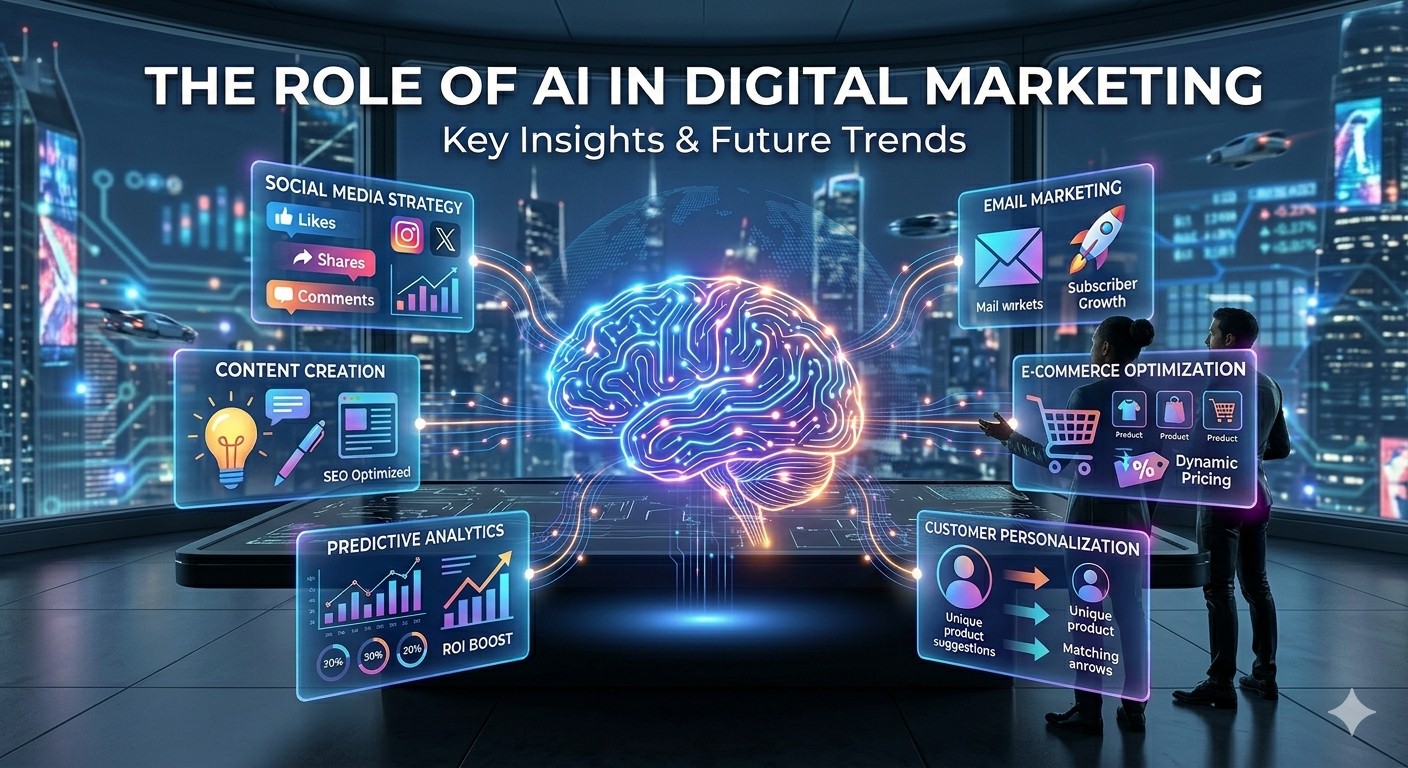
How is AI actually changing the daily workflows of marketing teams? It generally falls into four core areas:
1. Hyper-Personalization at Scale
Generic, one-size-fits-all campaigns are quickly becoming a relic. AI enables brands to deliver tailored messaging that evolves in real-time based on individual behavior. Whether it’s product recommendations on an e-commerce site or dynamic email content, AI ensures that every customer touchpoint feels relevant.
2. Predictive Analytics and Forecasting
Instead of reacting to last month’s report, AI allows marketers to be proactive. By analyzing historical data, machine learning models can predict future customer actions, such as purchase intent, churn risk, or lifetime value. This enables budget allocation toward the most promising leads before they even reach your website.
3. Content Creation and Optimization
Generative AI has revolutionized the creative process. From brainstorming blog topics and drafting social media copy to generating high-quality imagery and video, AI shortens creative timelines. However, the most successful brands use AI to handle the volume, while human teams retain the voice to ensure authenticity.
4. Real-Time Performance Optimization
In paid media, AI has already become the standard. Algorithms now autonomously manage bidding strategies, swap creative variants, and reallocate budgets across channels to maximize Return on Investment (ROI). These systems constantly learn from in-flight performance, making adjustments faster than any human team could.
The “Readiness” Gap: Why Strategy Still Rules
While the capabilities of AI are vast, the technology is only as effective as the data beneath it. There is a common trap many organizations fall into: they try to use AI to scale a weak strategy.
If your foundational marketing discipline such as your Ideal Customer Profile (ICP), attribution modeling, and brand positioning is not clearly defined, AI will simply scale your inefficiencies. The most successful organizations today are those that:
- Audit their data: They ensure their customer data is clean, unified, and accessible.
- Set clear guardrails: They use AI to execute, but human experts define the “rules of the road” for brand safety and messaging.
- Prioritize ethics: They are transparent about data usage and vigilant about mitigating algorithmic bias.
The Path Forward
AI is no longer a niche topic for technologists; it is a core competency for every marketer. As we look toward the next few years, we will see the rise of “agentic” marketing, where AI agents begin to orchestrate campaigns autonomously across fragmented channels.
The winners in this new era will not necessarily be the ones who adopt the most tools the fastest. They will be the ones who treat AI as a partner using its analytical power to amplify human creativity and judgment, ultimately building stronger, more meaningful connections with their customers.
Are you ready to integrate AI into your marketing strategy, and if so, which of these four pillars do you feel is the biggest priority for your team right now?